
Batam’s Port Story Is Starting to Change
For decades, Batam has benefited from one of Southeast Asia’s most strategic locations: close to Singapore and directly adjacent to the shipping lanes of the Malacca Strait.
But geographic advantage alone does not create a logistics hub.
What matters to manufacturers and investors is whether containers can move reliably, frequently, and competitively between Batam and major markets without unnecessary transshipment, handling, delays, and additional costs.
The latest numbers from Batu Ampar suggest that this is beginning to happen at a much larger scale.
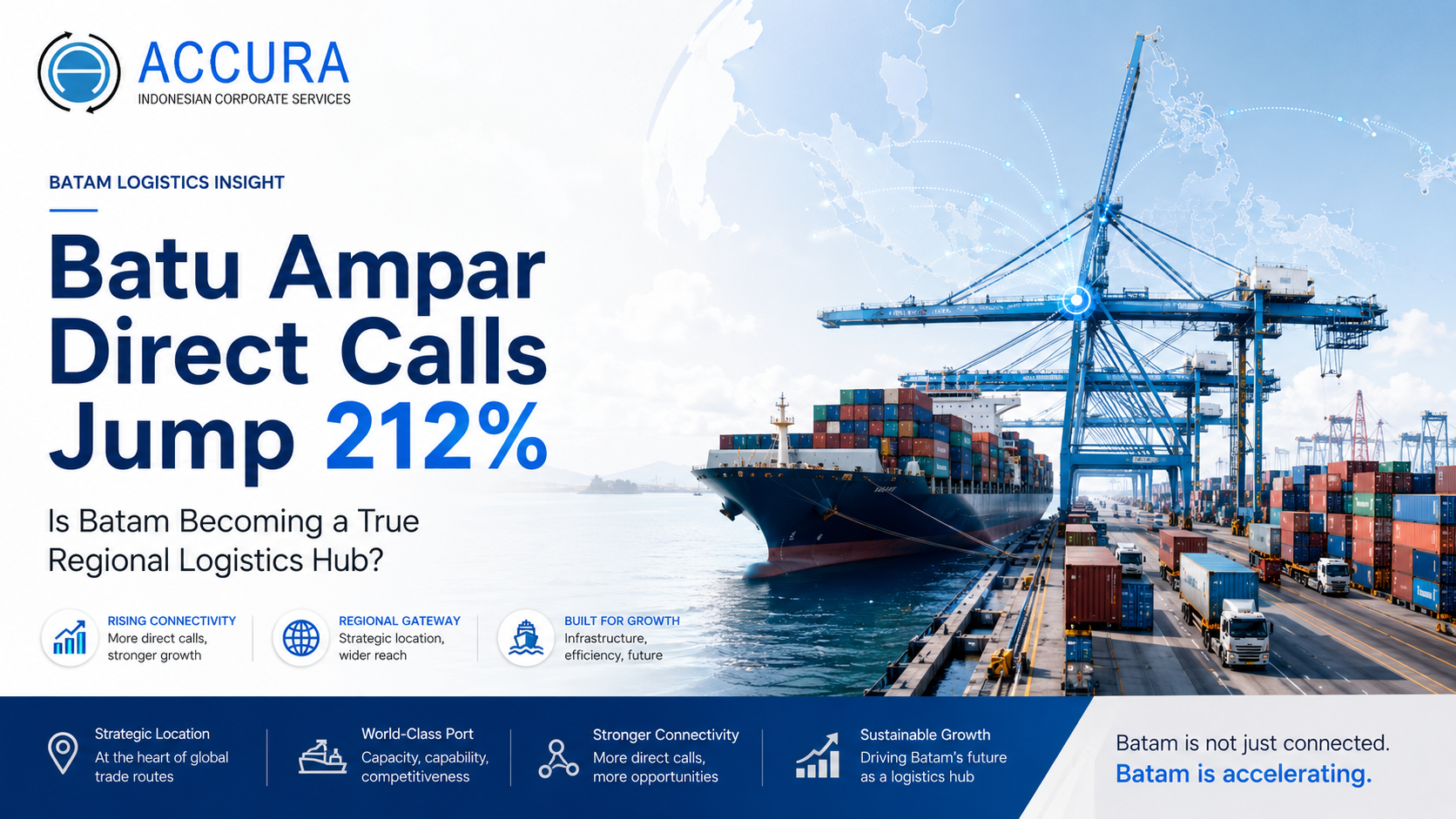
According to operational data published by BP Batam, international direct calls at Batu Ampar Container Terminal increased from 34 calls in January–May 2025 to 106 calls during the same five months of 2026—an increase of 212%.
Container volume carried through these direct-call services rose from 25,904 TEUs to 58,237 TEUs, representing growth of approximately 125% year-on-year.
That combination—more vessels and substantially more containers—is more significant than either statistic on its own.
Batu Ampar Direct-Call Growth at a Glance
| Indicator | Jan–May 2025 | Jan–May 2026 | Change |
| International direct calls | 34 | 106 | +212% |
| Direct-call container volume | 25,904 TEUs | 58,237 TEUs | +125% |
| Major direct-call shipping lines | 2 | 4 | Network expanded |
Source: BP Batam / Batu Ampar Container Terminal operational data.
As of August 2026, BP Batam's broader operational dashboard for Terminal Umum Batu Ampar also reports 340,869 TEUs of container traffic during January–June 2026, alongside 3,885 vessel calls and more than 6.3 million gross tonnes of vessel traffic.
These broader figures should not be confused with the direct-call-only data, but together they show the increasing scale of activity around Batu Ampar.
It Is Not Just More Ships—More Carriers Are Coming
One of the strongest indicators of an emerging logistics node is carrier diversification.
During January–May 2025, international direct-call services at Batu Ampar were primarily operated by SITC and Evergreen.
By the same period in 2026, Samudera and COSCO Shipping had joined the network.
BP Batam reported the following activity during January–May 2026:
- SITC: 55 calls and 32,266 TEUs
- Evergreen: 30 calls and 14,792 TEUs
- Samudera: 11 calls and 7,103 TEUs
- COSCO Shipping: 10 calls and 4,077 TEUs
For manufacturers, this matters.
A port served by multiple carriers can potentially provide greater schedule flexibility, more routing options, stronger competition between service providers, and reduced dependence on a single shipping network.
That makes logistics planning more resilient.
Batu Ampar Is Building an Intra-Asia Network
The direct-call network is also becoming geographically broader.
According to BP Batam, Batu Ampar's international direct services are now connected with ports including Shanghai, Ningbo, Shekou, Nansha, Yangpu, and Qinzhou in China; Haiphong and Ho Chi Minh City in Vietnam; Port Klang, Kuantan, Kota Kinabalu, and Kuching in Malaysia; as well as Singapore, Laem Chabang in Thailand, Sihanoukville in Cambodia, and Yangon in Myanmar.
BP Batam describes the network as reaching at least seven major Asian countries.
This is particularly relevant for Batam because much of the island's industrial ecosystem depends on regional manufacturing and supply-chain relationships.
Instead of viewing Batam only as an Indonesian manufacturing location close to Singapore, investors can increasingly evaluate it as a location with its own direct maritime links into major Asian supply chains.
That distinction is important.
The Batam–Shanghai Route Shows Why Direct Calls Matter
The economic value of direct calls becomes clearer when looking at actual logistics costs.
BP Batam reported in July 2026 that shipments on the Batam–Shanghai route could cost approximately US$650–800 per 20-foot container under the direct-call model.
Under the previous feeder model involving transshipment through Singapore, BP Batam cited costs of approximately US$950–1,100 per container.
According to BP Batam, this can translate into potential savings of up to around US$300 per container, with logistics efficiency improvements estimated at approximately 30–50% depending on the shipment, while shipping time to Shanghai can be reduced to around eight days.
For a company exporting several containers a month, the impact may already be material.
For a large manufacturer shipping hundreds or thousands of containers annually, the cumulative effect can become a strategic consideration in plant-location decisions.
Direct routes can also reduce the number of cargo-handling stages within a journey.
That may help companies improve:
- freight-cost predictability;
- shipment visibility;
- inventory planning;
- delivery reliability;
- safety-stock requirements; and
- overall supply-chain lead times.
The actual benefit will still depend on shipping line, cargo, container type, contract rates, sailing schedule, destination, Incoterms, and other operational factors.
The Terminal Itself Is Becoming Faster
Shipping connectivity would mean much less if the terminal could not handle vessels efficiently.
This is where Batu Ampar's latest operational improvements become particularly relevant.
BP Batam reported in July 2026 that Container Handling Productivity increased from 18 to 24 BCH (box crane per hour), an improvement of approximately 33%.
Ship Handling Productivity increased from 12 to 40 BSH, while average vessel turnaround time was reduced from around 20 hours to seven hours. Waiting time also fell from approximately 1.4 hours to 0.6 hours.
These are important indicators because port competitiveness is ultimately about time as much as infrastructure.
A modern crane means little if a ship still waits hours to berth.
Similarly, a direct shipping route becomes less attractive if terminal operations create unpredictable delays.
The data therefore suggests that Batu Ampar's progress is not limited to adding shipping services—it is also improving its ability to process those services.
US$85 Million Is Being Put Behind the Transformation
The improvements are supported by physical and operational investment.
BP Batam reported that approximately US$85 million has been invested in the Batu Ampar Container Terminal transformation, covering areas such as cargo-handling equipment, container-yard development, terminal capacity, and service digitalisation.
This helps explain why several operational metrics are improving simultaneously.
Rather than simply marketing Batu Ampar as a regional gateway, the authorities and terminal operators are investing in the infrastructure needed to support higher cargo volumes.
During January–May 2026 alone, Batu Ampar Container Terminal recorded 221,183 TEUs of total container throughput. Exports accounted for approximately 71,930 TEUs, or 32.5% of the total.
That export component is important because a sustainable logistics hub requires cargo.
Ships will not maintain high-frequency services merely because a port has modern equipment. They need sufficient and consistent commercial volumes.
Batam's manufacturing base therefore becomes one of Batu Ampar's biggest strategic advantages.
So, Is Batam Already a True Regional Logistics Hub?
Not quite—but it is getting substantially closer.
The distinction matters.
A port receiving international direct calls is not automatically a regional transshipment hub.
A genuine logistics hub usually combines several characteristics:
1. High Service Frequency
Manufacturers need multiple sailings and reliable schedules rather than occasional direct connections.
Batu Ampar is progressing on this front. BP Batam reported that some direct-call services using vessels with capacities of around 1,200–2,000 TEUs increased from approximately six to seven sailings per month to 10–13 sailings per month.
2. Carrier Diversity
The expansion from two major international direct-call operators to four is a positive sign because route competition and network optionality are increasing.
3. Strong Port Productivity
The improvement in crane productivity, turnaround time, and vessel waiting time indicates that Batu Ampar is developing the operational performance expected by international shipping lines.
4. Sufficient Cargo Density
This may ultimately be Batam's strongest advantage.
Batu Ampar is located next to one of Indonesia's most concentrated manufacturing ecosystems. Export cargo generated by electronics, machinery, precision engineering, marine, and other industrial activities can provide the base volumes needed to support shipping services.
5. A Real Transshipment Role
This remains the bigger test.
BP Batam has previously described a multi-stage development strategy under which Batu Ampar would evolve from a domestic transshipment terminal into a direct-call terminal and ultimately an international transshipment port. An earlier development plan envisioned infrastructure capable of eventually accommodating approximately 1.6 million TEUs, including expanded container yards, longer berths, additional quay cranes, RTGs, and terminal trucks.
The direct-call surge suggests that one important part of that strategy is materialising.
But the next question is whether Batu Ampar can develop sufficient network density to become a location where cargo is not only imported into or exported from Batam, but also consolidated and redistributed across the region.
That would represent the transition from an efficient industrial port to a true regional hub.
Batam Does Not Need to Replace Singapore to Win
This may be the most important point for investors.
Batam does not need to replace Singapore as Southeast Asia's dominant maritime hub for Batu Ampar's transformation to create significant economic value.
A more realistic—and potentially more attractive—scenario is for Batam to become a complementary manufacturing and logistics node within the Singapore–Johor–Batam regional ecosystem.
Singapore can continue serving as a major global shipping, financial, and logistics centre while Batam builds competitive direct services for industrial cargo that does not necessarily need to be routed through Singapore.
For manufacturers, that creates a potentially valuable combination:
Batam for production + increasingly direct regional connectivity + Singapore nearby for global business services and network access.
The 212% increase in direct calls therefore matters not because Batam is suddenly competing head-to-head with the world's largest container hubs.
It matters because one of Batam's historical logistics constraints—dependence on feeder and transshipment arrangements—is starting to become less absolute.
What Manufacturers and Investors Should Review Now
Companies already operating in Batam should not assume that shipping structures established several years ago are still optimal.
The changing network creates a reason to reassess logistics strategies.
Manufacturers should consider comparing:
Direct call vs Singapore transshipment
Determine whether new direct services now offer better freight rates, sailing frequency, lead time, and schedule reliability for your key markets.
Inventory requirements
More predictable transit times could potentially allow adjustments to safety stock or buffer inventory.
Supplier and customer geography
Companies heavily connected to China, Vietnam, Malaysia, Thailand, and other Asian manufacturing centres may benefit most from the expanding route network.
Incoterms and freight responsibility
Exporters should review whether logistics improvements create opportunities to renegotiate freight responsibility or commercial terms with customers and suppliers.
Warehouse and distribution strategy
Increasing cargo volumes could strengthen the business case for regional consolidation, warehousing, fulfilment, and value-added logistics activities in Batam.
Future facility location
For investors comparing Batam with other Southeast Asian manufacturing locations, port connectivity should now receive greater weight in site-selection models than it may have several years ago.
The Bigger Investment Signal
The most important takeaway from Batu Ampar's 212% direct-call growth is not the percentage itself.
The increase came from a relatively low base—34 calls to 106 calls—so the headline percentage should be interpreted carefully.
What makes the development more meaningful is that several indicators are moving together:
more shipping lines, more direct routes, higher container volumes, faster handling, shorter vessel turnaround times, lower waiting times, and significant investment in terminal infrastructure.
That combination suggests a structural change rather than a single temporary spike.
Batam may therefore not yet be a fully developed regional transshipment hub, but it is increasingly becoming something equally important for investors:
a manufacturing centre with credible direct access to regional maritime supply chains.
And if that connectivity continues to deepen, the investment case for locating production, distribution, and regional supply-chain activities in Batam will become considerably stronger.
Planning to Use Batam as Your Manufacturing or Regional Supply-Chain Base?
Improving port connectivity can strengthen Batam's investment proposition, but logistics is only one part of a successful market-entry strategy.
Investors must also evaluate the right company structure, business classification, industrial location, licensing requirements, import-export arrangements, customs procedures, manpower requirements, and operational compliance before establishing or expanding their presence.
Accura can assist investors in evaluating and establishing operations in Batam and Indonesia—from company establishment and licensing to investment advisory and ongoing regulatory compliance.
If your company is considering Batam as a manufacturing, distribution, logistics, or regional operating base, talk to our team before making the final location decision.
Visit: accura.co.id
Accura — Helping businesses establish, operate, and grow in Indonesia.