
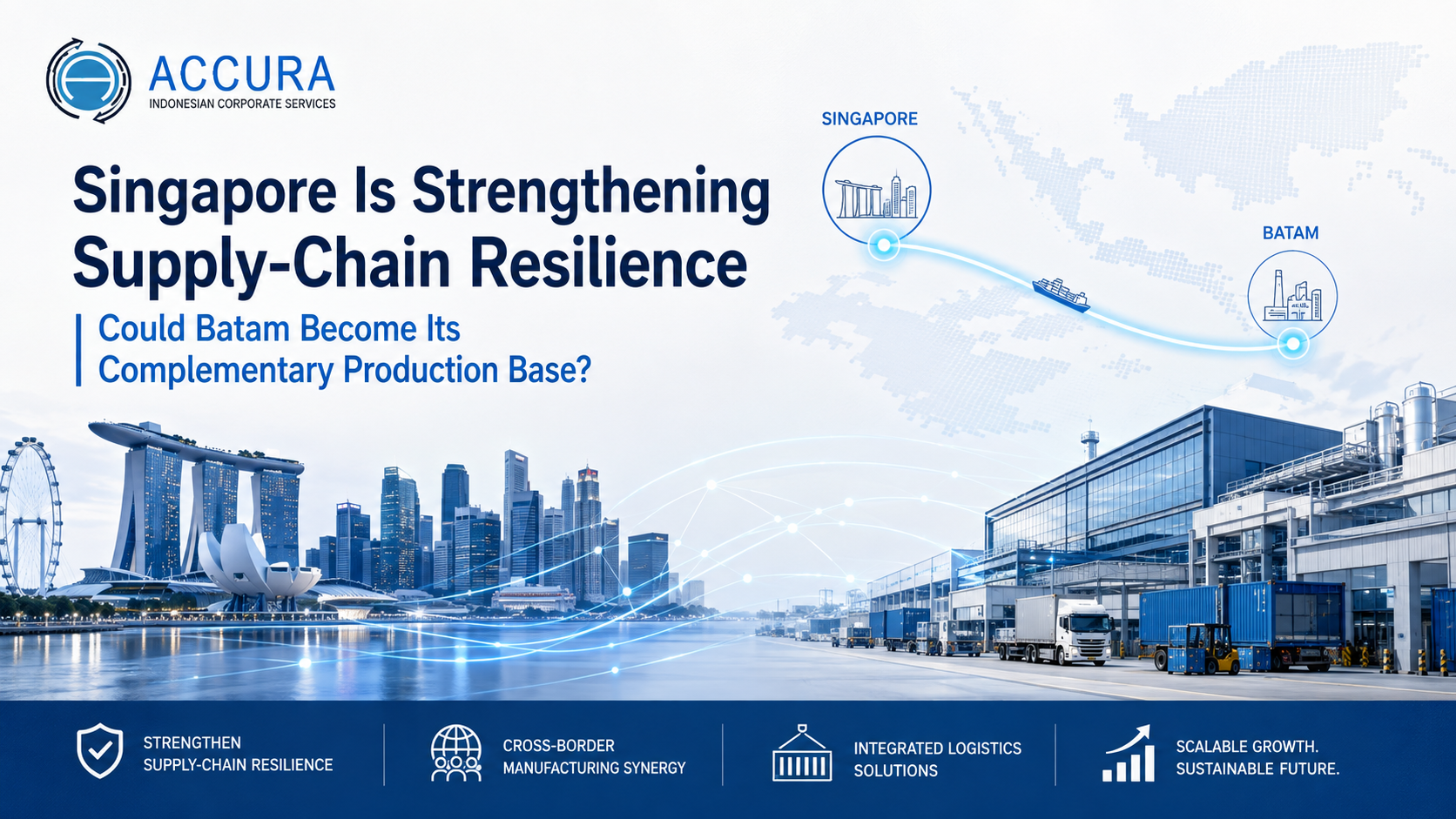
Global supply chains are entering a period in which resilience is becoming as important as efficiency.
Tariffs, export controls, geopolitical competition, shipping disruptions and stricter scrutiny of product origin are forcing manufacturers to reconsider where products are designed, produced, assembled and distributed.
Singapore has responded by strengthening international trade partnerships, helping companies diversify suppliers and supporting the reconfiguration of manufacturing operations. However, this does not mean Singapore is moving away from manufacturing.
Instead, Singapore is increasingly positioning itself as a high-value manufacturing, innovation and supply-chain management hub connected to complementary production locations across Southeast Asia.
One of the most relevant locations in this emerging regional model is Batam.
Located close to Singapore and already home to a substantial manufacturing ecosystem, Batam could offer companies additional production capacity while Singapore continues to host regional headquarters, research and development, intellectual-property management and advanced corporate functions.
The result could be a more integrated Singapore–Batam production network rather than a competition between the two locations.
Why Is Singapore Strengthening Its Supply-Chain Resilience?
Singapore is highly connected to international trade. This connectivity has helped it become a major logistics, advanced-manufacturing and regional-headquarters hub, but it also means businesses operating there are exposed to changes in global trade rules and external supply disruptions.
In April 2025, Singapore established the Singapore Economic Resilience Taskforce. The government warned that fragmented trade flows would require companies to reassess their production and supply-chain configurations and invest more heavily in resilience instead of focusing solely on cost efficiency.
Singapore has since introduced more direct support for companies reorganising their operations.
The Business Adaptation Grant, or BizAdapt, supports supply-chain optimisation, market diversification, changes of suppliers and the relocation or establishment of manufacturing operations in alternative locations. From 1 April 2026, eligible support was enhanced to as much as 70% for SMEs and 50% for non-SMEs, capped at S$100,000 per enterprise.
Singapore is also broadening its international economic partnerships. In October 2025, Singapore and New Zealand agreed on Singapore’s first legally binding bilateral supply-chain resilience agreement for essential goods. Singapore is also participating in wider initiatives such as the Indo-Pacific Economic Framework Supply Chain Agreement, which establishes mechanisms for cooperation during supply disruptions.
These developments indicate that supply-chain diversification is no longer simply a private business decision. It has become part of Singapore’s broader economic strategy.
Singapore Is Not Abandoning Manufacturing
Regionalisation should not be interpreted as Singapore transferring all production activities overseas.
Singapore continues to invest in technologically advanced and high-value manufacturing. Its Manufacturing 2030 vision aims to increase manufacturing value-added by 50% from 2020 to 2030.
Singapore remains an important global manufacturing node, accounting for approximately one in ten chips produced globally and one-fifth of worldwide semiconductor-equipment production. Its strengths include skilled technical talent, research institutions, intellectual-property protection, global connectivity and advanced industrial infrastructure.
The more likely strategy is therefore a division of functions:
- Singapore hosts regional management, innovation, R&D, engineering and complex production.
- Nearby locations provide additional space, labour, assembly capacity and production scale.
- The entire network is connected through regional logistics, digital supply-chain management and coordinated compliance systems.
Singapore’s Economic Development Board has referred to this approach as the SG+ twinning model.
Under the model, companies combine Singapore’s business and innovation advantages with neighbouring industrial locations in Johor and Indonesia’s Batam–Bintan–Karimun region. The objective is to develop synergistic manufacturing bases, diversify production and expand across Southeast Asia.
Why Batam Fits the Complementary Production Model
Batam’s main advantage is not simply that it is geographically close to Singapore.
Its value comes from the combination of proximity, existing industrial activity, investment momentum, designated economic facilities and a history of cross-border manufacturing.
In December 2025, Singapore’s Economic Development Board described the Batam–Bintan–Karimun region as a complementary ecosystem for global companies using Singapore as a Southeast Asian base.
The region is accessible from Singapore by ferry, contains more than 20 industrial parks and hosts businesses in manufacturing, logistics, information technology and data centres. The wider BBK area includes Free Trade Zone and Special Economic Zone facilities offering different forms of fiscal, customs, infrastructure and licensing support, subject to the applicable location and qualifying requirements.
The economic relationship is already substantial.
During the first half of 2025, Singapore investment in Batam reached approximately Rp7.9 trillion, representing about 69% of Batam’s foreign direct investment during that period. Singapore had also been Batam’s largest foreign investor since 2023.
The trend continued in 2026. Batam recorded total investment of Rp29.89 trillion in the first half of 2026, an increase of 62.75% compared with the first half of 2025.
Singapore remained the largest source country, contributing approximately Rp10.89 trillion. Investment in machinery, electronics, medical instruments, electrical equipment, precision equipment and optical products reached around Rp6.07 trillion. Manufacturing accounted for approximately 57.01% of Batam’s regional economy, showing that industrial activity remains central to the city’s economic structure.
These figures suggest that Batam is no longer only a potential partner in Singapore’s regional production strategy. The integration is already taking place.
What Could a Singapore–Batam Operating Model Look Like?
A complementary production structure does not require every company to divide its activities in exactly the same way. The right structure depends on the product, supply chain, tariff exposure, intellectual property, customer location and licensing requirements.
A common model could allocate the following functions to Singapore:
Functions Retained in Singapore
- Regional headquarters and strategic decision-making
- Product design and engineering
- Research and development
- Intellectual-property ownership and management
- Treasury, financing and regional procurement
- Advanced automation and specialised manufacturing
- Quality-control systems and supply-chain coordination
- Commercial access to international customers and investors
Batam could then accommodate functions such as:
Functions Located in Batam
- Larger-scale manufacturing and assembly
- Component production
- Packaging and selected testing activities
- Labour-intensive production processes
- Regional warehousing and inventory buffers
- Supplier development
- Repair, maintenance and industrial support services
- Data-centre and digital operations in suitable industrial areas
This structure is not theoretical.
Singapore EDB has highlighted companies that have operated across Singapore and BBK for decades, including Schneider Electric and Alcon. PC Partner Technology also invested more than US$10 million in a graphics-card manufacturing facility in Batam.
Another example is Sunningdale Tech, which uses its Batam facility for production while retaining product design and selected advanced processes in Singapore. The proximity between the Batam factory and Singapore operations allows the company to exchange production and testing feedback more efficiently.
Which Industries Are Most Suitable?
The Singapore–Batam model may be particularly relevant to industries that require both high-level technical capabilities and scalable production.
Electronics and Semiconductor-Related Manufacturing
Batam has a long-established electronics and electrical manufacturing base. Companies can potentially maintain R&D, engineering, regional procurement and sensitive technical functions in Singapore while allocating selected assembly, packaging, component manufacturing or supporting operations to Batam.
Precision Engineering
Precision manufacturing often requires a mix of highly automated activities and labour-supported processes. This makes it suitable for a carefully divided Singapore–Batam operating structure.
Medical Technology
Singapore provides a strong regulatory, R&D and high-value manufacturing environment, while Batam may support selected component production, assembly, packaging and supply-chain operations, subject to product standards and regulatory requirements.
Data Centres and Digital Infrastructure
Batam’s proximity to Singapore, expanding digital ecosystem and new industrial developments have increased interest in data-intensive operations. Singapore EDB has highlighted projects such as the Tembesi Innovation District, which is planned with dedicated utilities, water treatment, wastewater recycling and access to a solar facility of up to 200 megawatts.
Logistics and Regional Distribution
A Singapore–Batam structure can also support inventory diversification. Instead of concentrating all stock, production and suppliers in one jurisdiction, companies can design multiple storage, manufacturing and distribution points.
Green and Low-Carbon Manufacturing
Newer Batam industrial developments are increasingly incorporating renewable energy, energy-efficient buildings and integrated utility systems. These features may be relevant to manufacturers facing sustainability requirements from customers, financial institutions and international supply-chain partners.
Potential Strategic Benefits for Manufacturers
A properly structured Singapore–Batam production network could provide several advantages.
1. Reduced Dependence on a Single Production Location
Dividing critical processes, suppliers and inventory across more than one location can reduce the operational impact of disruptions affecting a single facility.
2. Preservation of Singapore’s High-Value Functions
Companies do not necessarily have to choose between Singapore and Batam. They can continue benefiting from Singapore’s talent, financing, R&D ecosystem and global connectivity while using Batam for complementary industrial capacity.
3. Additional Production Space and Workforce Capacity
Batam can provide room for larger production facilities, supporting operations and supplier development within close reach of Singapore-based management teams.
4. Stronger Access to Indonesia
A properly established Indonesian operation can help companies serve Indonesian customers and participate more directly in the country’s industrial and supply-chain ecosystem.
5. Greater Flexibility in Responding to Trade Changes
A multi-location structure may give companies more options when responding to tariffs, customer localisation requirements, supplier disruptions or changes in export-control policies.
However, diversification only improves resilience when the operating structure is legally compliant and commercially integrated. Establishing a second factory without coordinating suppliers, inventory, information systems and logistics may merely create additional complexity.
Important Compliance Issues to Assess
Batam’s proximity to Singapore should not lead companies to treat a cross-border manufacturing arrangement as a simple factory relocation.
Singapore and Indonesia remain separate jurisdictions with different corporate, customs, employment, tax and licensing systems.
Indonesian Company and Investment Structure
Foreign investors commonly need to evaluate whether the Batam operation should be established as a foreign-investment company, or PT PMA, together with the appropriate shareholding, capitalisation and business classifications.
KBLI and Risk-Based Licensing
Each proposed activity must be mapped to the appropriate Indonesian Standard Business Classification, or KBLI.
Government Regulation No. 28 of 2025 replaced the previous risk-based licensing regulation and requires business licensing, supporting licences and basic requirements to be processed through Indonesia’s Online Single Submission system according to the risk level of the activity.
Depending on the project, the company may need to address:
- A Business Identification Number or NIB
- Standard certificates or sectoral permits
- Spatial-utilisation approval
- Environmental approval
- Building approval
- Industrial business requirements
- Import and customs registrations
- Product-specific licences
- Employment and foreign-worker approvals
FTZ and Customs Treatment
Batam’s Free Trade Zone facilities can create meaningful advantages for eligible activities and goods. Nevertheless, the treatment of machinery, raw materials, components and finished goods must be reviewed based on their origin, destination, customs status and movement between the FTZ, Singapore and the rest of Indonesia.
Companies should not assume that every Batam transaction will automatically receive the same exemption.
Rules of Origin and Trade Compliance
Manufacturers must evaluate whether processing performed in Batam satisfies the applicable rules of origin for the destination market.
Routing goods through Batam or conducting only minimal processing should not be treated as a strategy for avoiding tariffs or export restrictions. Production records, bills of materials, supplier documentation and value-added calculations should support the declared origin and customs treatment.
Singapore authorities have also warned that businesses should expect greater scrutiny of their production and supply chains, particularly for products affected by economic-security policies, tariffs and technology controls.
Tax and Transfer Pricing
Transactions between Singapore and Indonesian group companies must be commercially supported. Management fees, royalties, component pricing, financing arrangements and service charges should be documented and reviewed from both jurisdictions.
Land and Environmental Due Diligence
Before selecting a Batam site, investors should verify:
- Land allocation and permitted use
- Industrial-estate status
- Access to power and water
- Wastewater and hazardous-waste arrangements
- Port and road connectivity
- Environmental-document requirements
- Expansion capacity
- Construction and building approvals
A Practical Roadmap for Companies
Businesses considering a Singapore–Batam structure should approach the project in stages.
First, map the existing supply chain. Identify critical suppliers, production processes, customer markets, logistics routes, tariff exposure and potential single points of failure.
Second, divide functions strategically. Determine which activities should remain in Singapore and which activities can be located in Batam without compromising quality, intellectual property or customer requirements.
Third, conduct regulatory due diligence. Confirm the Indonesian corporate structure, KBLI classifications, foreign-investment conditions, industrial location, FTZ treatment, environmental requirements and OSS licensing pathway.
Fourth, calculate the total landed cost. The assessment should include production, labour, rent, utilities, customs, shipping, insurance, inventory, taxation and cross-border management costs—not only headline factory expenses.
Fifth, establish traceability systems. Inventory, supplier, origin, quality and production data should be visible across both jurisdictions.
Sixth, begin with a controlled implementation. A pilot production line or selected product category can help identify operational and compliance issues before a larger relocation or expansion.
Could Batam Become Singapore’s Complementary Production Base?
The evidence increasingly suggests that it can—and, for some industries, already has.
Singapore is strengthening its position as a trusted location for advanced manufacturing, innovation, regional management and global connectivity. At the same time, its government is encouraging companies to diversify suppliers, reassess production configurations and build more resilient regional operations.
Batam offers nearby industrial capacity, an established manufacturing ecosystem, significant Singapore investment and expanding infrastructure for electronics, precision engineering, digital industries and higher-value manufacturing.
The strongest opportunity is therefore not to frame Batam as a replacement for Singapore.
It is to build an integrated model in which Singapore functions as the regional control tower and innovation centre, while Batam provides complementary production capacity and operational scale.
Companies that design this structure carefully may achieve more than lower operating costs. They may build a supply chain that is more flexible, diversified and capable of responding to future trade disruptions.
Planning a Singapore–Batam Manufacturing Structure?
Establishing a complementary production base requires coordinated decisions covering company establishment, foreign ownership, KBLI classification, industrial location, OSS licensing, environmental approval, customs treatment and ongoing corporate compliance.
Accura can assist foreign investors and Singapore-based companies in evaluating and establishing operations in Batam and other Indonesian locations.
Our support includes:
- PT PMA establishment
- KBLI and business-activity analysis
- OSS and risk-based licensing
- Industrial and environmental licensing coordination
- Corporate legal documentation
- Foreign-investment compliance
- Post-establishment corporate support
Explore your Singapore–Batam expansion strategy with Accura. Visit accura.co.id to speak with our advisory team.