
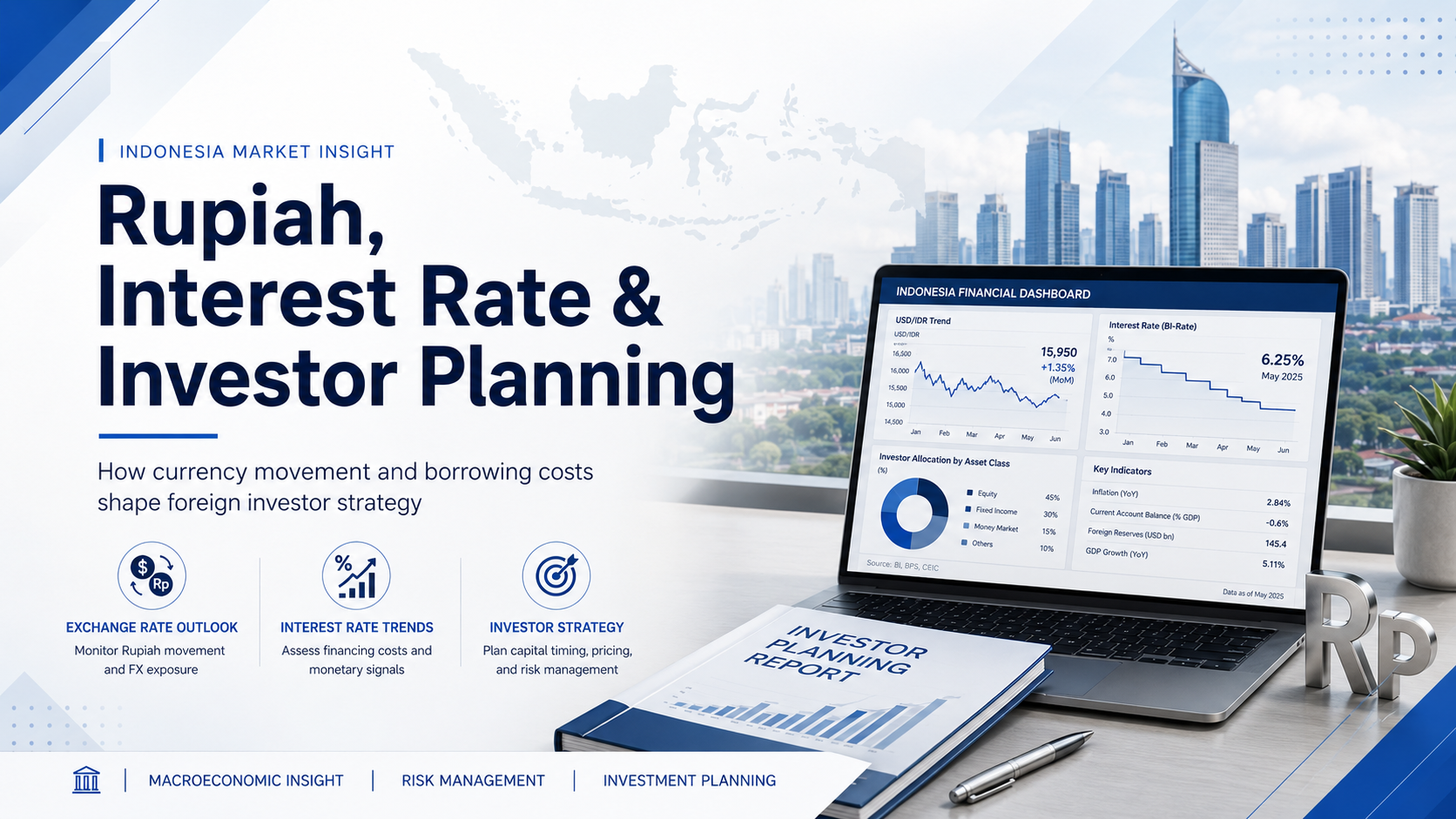
Indonesia remains one of Southeast Asia’s most important investment destinations, but 2026 has also shown that foreign investors need to pay closer attention to currency movement, interest rates, inflation, and capital planning.
For companies entering or expanding in Indonesia, the Rupiah exchange rate and Bank Indonesia’s interest rate policy are not just macroeconomic indicators. They directly affect investment budgets, capital injection timing, loan costs, import expenses, dividend planning, and overall project feasibility.
As of June 2026, Bank Indonesia has taken a more stability-focused stance. The BI-Rate was raised to 5.75% on 18 June 2026, while the Deposit Facility rate and Lending Facility rate were also increased to 4.75% and 6.50% respectively. Bank Indonesia stated that the move was aimed at strengthening Rupiah stability and keeping inflation within the official target corridor of 2.5% ± 1% in 2026 and 2027.
Latest Indonesia Macro Snapshot for Investors
| Indicator | Latest Data | Why It Matters for Investors |
|---|---|---|
| BI-Rate | 5.75% as of 18 June 2026 | Higher rates can increase borrowing costs but may support currency stability. (Bank Indonesia) |
| USD/IDR JISDOR | Rp17,942 per USD on 25 June 2026 | Used as a reference rate for monitoring Rupiah movement. (Bank Indonesia) |
| BI USD transaction rate | Sell Rp18,044.78 / Buy Rp17,865.22 on 25 June 2026 | Useful for treasury and cash conversion assumptions. (Bank Indonesia) |
| May 2026 inflation | 3.08% yoy | Inflation affects pricing, wage assumptions, and operating costs. (Badan Pusat Statistik Indonesia) |
| Q1 2026 GDP growth | 5.61% yoy | Shows continued domestic growth momentum. (Badan Pusat Statistik Indonesia) |
| Q1 2026 investment realization | Rp498.8 trillion | Indicates continued investment activity despite global volatility. (Antara News) |
| U.S. Fed Funds Rate | 3.50%–3.75% as of 17 June 2026 | Global dollar interest rates influence capital flows into emerging markets. (federalreserve.gov) |
Why the Rupiah Matters in Investor Planning
Foreign investors usually prepare their investment budget in USD, EUR, SGD, JPY, or another foreign currency. However, many operational costs in Indonesia are paid in Rupiah, including local salaries, rent, utilities, professional services, taxes, and vendor payments.
A weaker Rupiah can create both opportunities and risks. For investors bringing in foreign currency, a weaker Rupiah may make local costs appear cheaper when converted from USD or SGD. However, the same movement can increase the cost of imported machinery, raw materials, technology licenses, foreign debt repayment, and overseas service contracts.
This is why investors should not rely on a single exchange rate assumption. A proper investment plan should include at least three scenarios: base case, stronger Rupiah case, and weaker Rupiah case.
Interest Rates: What the BI-Rate Means for Business
The BI-Rate affects the broader cost of money in Indonesia. When Bank Indonesia raises its policy rate, banks may adjust lending rates, deposit rates, and financial product yields. For businesses, this can influence the cost of working capital loans, project financing, property financing, and local-currency debt.
Bank Indonesia’s June 2026 decision was not only about raising rates. BI also emphasized several supporting measures, including stronger foreign exchange intervention, maintaining attractive SRBI yields to attract foreign portfolio inflows, and providing a 10% reduction in hedging swap rates for non-resident investors.
For foreign investors, this means Indonesia is trying to balance two priorities: maintaining monetary stability while still supporting real-sector financing and economic growth.
What Investors Should Do Before Entering or Expanding in Indonesia
Foreign investors should update their feasibility study and investment model using the latest Rupiah and interest rate assumptions. The most important areas to review are:
1. Capital Injection Timing
Instead of converting all capital at once, investors may consider staged capital injection based on project milestones. This can reduce the risk of converting funds at an unfavorable exchange rate.
2. Currency Matching
If revenue is mostly in Rupiah, investors should be careful with excessive USD-denominated debt. Currency mismatch can create repayment pressure when the Rupiah weakens.
3. Import Cost Sensitivity
Businesses that rely on imported machinery, equipment, raw materials, or software licenses should calculate how a weaker Rupiah affects landed costs, customs duties, VAT, and final pricing.
4. Financing Structure
With BI-Rate at 5.75%, investors should compare local borrowing, foreign shareholder loans, equity injection, and hybrid financing structures before finalizing the capital plan.
5. Hedging Policy
Companies with recurring foreign currency exposure should prepare a clear hedging policy. This may include forward contracts, natural hedging through export revenue, or matching foreign currency liabilities with foreign currency income.
6. Pricing and Contract Clauses
Long-term supplier or customer contracts should include price adjustment clauses if foreign exchange movement materially affects cost structure.
Investment Momentum Remains Positive
Despite currency and interest rate pressures, Indonesia’s investment momentum remains active. In Q1 2026, investment realization reached Rp498.8 trillion, growing 7.2% year-on-year and representing 24.4% of the 2026 national investment target. Foreign Direct Investment accounted for 50.1% of total realization, while Domestic Direct Investment contributed 49.9%.
Key sectors contributing to investment realization included basic metals, services, mining, housing and industrial estates, transportation, warehousing, and telecommunications. Downstreaming-related projects also played a significant role, reaching around Rp147.5 trillion in Q1 2026.
This suggests that investors are still looking at Indonesia as a long-term market, especially in sectors linked to industrialization, infrastructure, logistics, digitalization, consumer demand, and value-added processing.
Practical Planning Checklist for Foreign Investors
Before committing capital, investors should prepare:
- Updated USD/IDR exchange rate scenarios.
- Interest rate sensitivity analysis for local and foreign debt.
- Import cost and working capital simulation.
- Tax and withholding tax review for shareholder loans or dividends.
- Hedging policy for foreign currency exposure.
- Capital injection schedule aligned with licensing and operational milestones.
- Compliance review for OSS, NIB, KBLI, corporate approvals, and sectoral permits.
- Exit and dividend repatriation planning.
Conclusion
Rupiah movement and interest rate policy should be treated as core elements of investor planning in Indonesia, not as secondary financial details. A stronger investment plan should combine legal setup, tax planning, treasury strategy, and operational forecasting.
Indonesia continues to offer strong long-term investment opportunities, supported by domestic demand, infrastructure development, downstreaming policy, and strategic market size. However, investors entering in 2026 should prepare a more disciplined financial model, especially around currency exposure, financing costs, and capital timing.
For foreign investors, the key question is not whether Rupiah volatility will happen, but whether the investment structure is ready to manage it.