
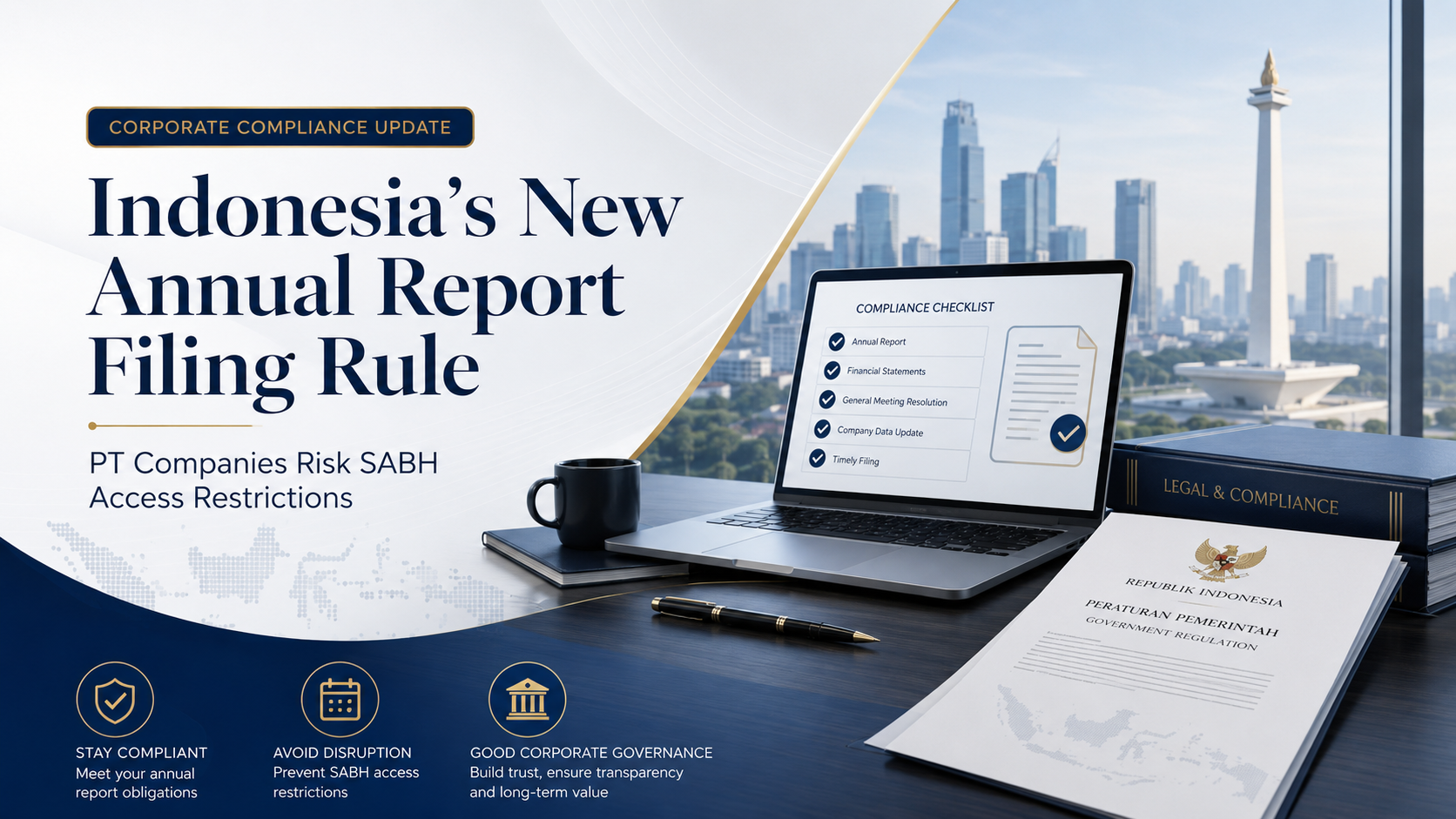
Indonesia has introduced a significant change to the annual compliance obligations of limited liability companies, or Perseroan Terbatas (PT).
Starting from 1 June 2026, capital partnership companies are required to electronically submit the approval of their annual reports through the Legal Entity Administration System, known as the Sistem Administrasi Badan Hukum or SABH.
The requirement is based on Minister of Law Regulation No. 49 of 2025 on the Requirements and Procedures for the Establishment, Amendment, and Dissolution of Limited Liability Company Legal Entities, commonly referred to as Permenkum No. 49/2025.
Companies that fail to fulfil the requirement may receive a written warning and, if the non-compliance continues, have their access to SABH blocked. According to the Directorate General of General Legal Administration, or Ditjen AHU, the electronic reporting mechanism began operating on 1 June 2026, while the administrative sanctions are expected to be implemented from November 2026.
For company directors, shareholders, foreign investors, and corporate secretarial teams, this is no longer merely an internal annual reporting exercise. It has become a formal government filing requirement with direct administrative consequences.
What Has Changed Under Permenkum No. 49/2025?
The obligation to prepare and approve annual reports is not entirely new.
Under Indonesia’s Company Law, Law No. 40 of 2007 as amended by Law No. 6 of 2023, a company’s board of directors must prepare an annual report and submit it to the General Meeting of Shareholders, or RUPS, after it has been reviewed by the board of commissioners.
The annual RUPS must generally be held no later than six months after the end of the company’s financial year.
The key change under Permenkum No. 49/2025 is that the approval of the annual report is no longer treated solely as an internal corporate matter.
The RUPS approval must now:
- Be recorded in a notarial deed
- Be submitted to the Minister of Law by the directors through a notary
- Be filed no later than 30 days after the notarial deed is signed and
- Be submitted electronically through SABH together with the required supporting documents.
This creates an additional compliance step after the annual RUPS has been completed.
Companies must therefore coordinate not only with their accounting and finance teams, but also with their commissioners, shareholders, corporate secretary, and notary.
Which Companies Are Covered?
The annual report filing requirement under Article 16 of Permenkum No. 49/2025 applies to a Perseroan persekutuan modal, or capital partnership company.
This generally covers conventional limited liability companies established by two or more shareholders, including:
- Foreign investment companies or PT PMA
- Domestic investment companies or PT PMDN
- Privately held limited liability companies
- Joint venture companies
- Subsidiaries of Indonesian or foreign corporate groups and
- Public companies, subject to additional capital-market requirements.
The regulation distinguishes these companies from an individual limited liability company, or Perseroan Perorangan.
An individual company has a separate obligation to submit an annual financial report through SABH. Its reporting form, deadlines, and potential sanctions are regulated separately under Articles 27 and 28 of Permenkum No. 49/2025.
Companies should therefore first confirm their legal classification before determining the correct annual reporting procedure.
Annual Report Filing Timeline
For companies whose financial year ends on 31 December, the general compliance sequence is as follows.
1. Prepare the annual report
The board of directors should prepare the annual report after the end of the financial year. Sufficient time should be provided for financial closing, reconciliation, preparation of management reports, and any required audit.
2. Review by the board of commissioners
The annual report must be reviewed by the board of commissioners before it is submitted to shareholders.
3. Hold the annual RUPS
The annual report must be submitted to the RUPS no later than six months after the financial year ends.
For a company with a financial year ending on 31 December, the annual RUPS would generally need to be held by 30 June of the following year.
4. Record the approval in a notarial deed
Permenkum No. 49/2025 requires the shareholders’ approval of the annual report to be documented in a notarial deed.
Companies should therefore arrange notarial involvement before holding the annual RUPS rather than treating the notarial process as an afterthought.
5. Submit the filing through SABH
The directors, acting through a notary, must submit the RUPS approval to the Minister of Law through SABH within 30 days from the date the notarial deed is signed.
Once the submission is accepted, the Minister of Law through Ditjen AHU will issue an electronic receipt or acknowledgement.
What Documents Must Be Uploaded?
The electronic submission must be accompanied by:
- The notarial deed containing the RUPS approval of the annual report and
- The company’s annual report.
The annual report must contain at least the following information.
Financial statements
The financial statements must include, at a minimum:
- A year-end balance sheet compared with the previous financial year
- A profit and loss statement
- A cash flow statement
- A statement of changes in equity and
- Notes to the financial statements.
Company activity report
The report should describe the company’s principal activities and material business developments during the financial year.
Social and environmental responsibility report
Companies must include information regarding the implementation of their social and environmental responsibilities where applicable.
Material issues affecting the company
The annual report must explain significant issues that arose during the year and affected the company’s business activities.
Board of commissioners’ supervisory report
The commissioners must report on the supervisory duties performed during the previous financial year.
Directors and commissioners
The report must identify the members of the board of directors and board of commissioners.
Remuneration information
The report must also include details of salaries and allowances for directors and salaries, honoraria, and allowances for commissioners for the previous year.
Because SABH filing requires the complete annual report, companies should review whether their current annual reporting format contains all seven mandatory categories.
Does the Annual Financial Statement Need to Be Audited?
Not every privately held company is automatically required to obtain an external audit. However, Article 68 of the Company Law requires an audit by a public accountant when the company meets certain conditions.
These include companies that:
- Collect or manage public funds
- Issue debt instruments to the public
- Are publicly listed companies
- Are state-owned limited liability companies
- Have assets or annual turnover of at least IDR 50 billion or
- Are otherwise required to undergo an audit under applicable laws and regulations.
Companies subject to mandatory audit requirements should account for the audit timeline when planning their annual RUPS and SABH filing.
Delays in completing the audit could affect the company’s ability to approve and file the annual report within the required period.
What Happens if a Company Does Not File?
Permenkum No. 49/2025 provides two main administrative sanctions for capital partnership companies that fail to submit the approved annual report or exceed the filing deadline.
Written warning
The first sanction is a written warning delivered through a notification in SABH and/or the company’s registered email address.
Companies should therefore ensure that their AHU account information and registered email addresses remain active and regularly monitored.
Blocking of SABH access
If the company does not fulfil its filing obligation within 30 days from the date of the written warning notification, its access to SABH may be blocked.
Blocking is defined as the closure of the company’s access to SABH.
The company may apply to have the block removed by submitting an application through SABH and uploading the outstanding documents, including the notarial deed approving the annual report and the annual report itself.
Access can be restored after Ditjen AHU receives and verifies the complete application.
Why SABH Access Matters for Business Operations
SABH is used for many important corporate legal processes in Indonesia, including:
- Establishing and registering a limited liability company
- Obtaining approval for amendments to the articles of association
- Reporting changes to company data
- Recording changes to directors and commissioners
- Processing mergers, acquisitions, and consolidations and
- Registering a company’s dissolution.
Consequently, a blocked SABH account may create practical difficulties when the company needs to complete corporate changes.
For example, a company undergoing an investment transaction may need to report changes in its shareholders, directors, commissioners, capital structure, or articles of association. If SABH access is blocked, these corporate actions may be delayed until the annual reporting issue has been resolved.
The restriction may therefore affect transaction timelines, corporate restructuring, financing arrangements, due diligence exercises, and internal governance changes.
These risks make annual report compliance especially important for foreign-owned companies and joint ventures that regularly require updates to their registered corporate information.
What Should Companies Do Before November 2026?
Although the administrative sanctions are expected to be implemented from November 2026, companies should not wait for enforcement to begin.
A practical compliance review should include the following steps.
Review previous annual RUPS records
Confirm whether annual RUPS meetings have been held for each required financial year and whether the reports were properly approved.
Check the company’s financial year
The deadline is calculated based on the company’s own financial year. Companies whose financial year does not end on 31 December must calculate their deadline separately.
Review the annual report format
Check whether the report includes all mandatory information required by Article 16 of Permenkum No. 49/2025.
Confirm whether an audit is required
Determine whether the company meets the statutory audit criteria under Article 68 of the Company Law or any sector-specific regulations.
Coordinate with the company’s notary
The RUPS approval must be recorded in a notarial deed and submitted through SABH by a notary. Early coordination can prevent administrative delays.
Monitor the 30-day filing period
The SABH filing deadline begins from the date the notarial deed is signed, not from the end of the financial year.
Keep evidence of submission
Retain the electronic receipt issued through SABH as part of the company’s statutory and corporate records.
Update AHU contact details
Ensure that the company’s registered email and AHU account information are accurate so that warnings or official notices are not missed.
What the New Rule Means for Foreign Investors
Foreign investors frequently focus on tax filings, investment activity reports, business licences, and sector-specific obligations when assessing the compliance status of an Indonesian subsidiary.
Permenkum No. 49/2025 adds another item to the corporate compliance calendar.
Investors conducting legal due diligence should now verify:
- Whether the company has held its annual RUPS
- Whether the annual report was properly approved
- Whether the approval was documented in a notarial deed
- Whether the filing was submitted through SABH within 30 days
- Whether the company received an electronic acknowledgement and
- Whether the company’s SABH access remains active.
This should be reviewed before an acquisition, capital injection, shareholder change, appointment of new directors, restructuring, or amendment to the articles of association.
Conclusion
Indonesia’s new annual report filing mechanism represents a shift from internal corporate governance toward digitally monitored regulatory compliance.
Under Permenkum No. 49/2025, capital partnership companies must hold their annual RUPS within the required period, document the approval of the annual report in a notarial deed, and submit it through SABH within 30 days.
Failure to comply may result in a written warning followed by the blocking of SABH access.
Companies should begin reviewing their annual reports, RUPS documentation, audit requirements, and AHU records now. Taking action before sanctions are implemented can help avoid disruptions to future corporate transactions and administrative services.
Accura can assist companies in reviewing their corporate compliance status, preparing annual RUPS documentation, coordinating notarial filings, and ensuring that required corporate information is properly submitted through Indonesia’s administrative systems.