
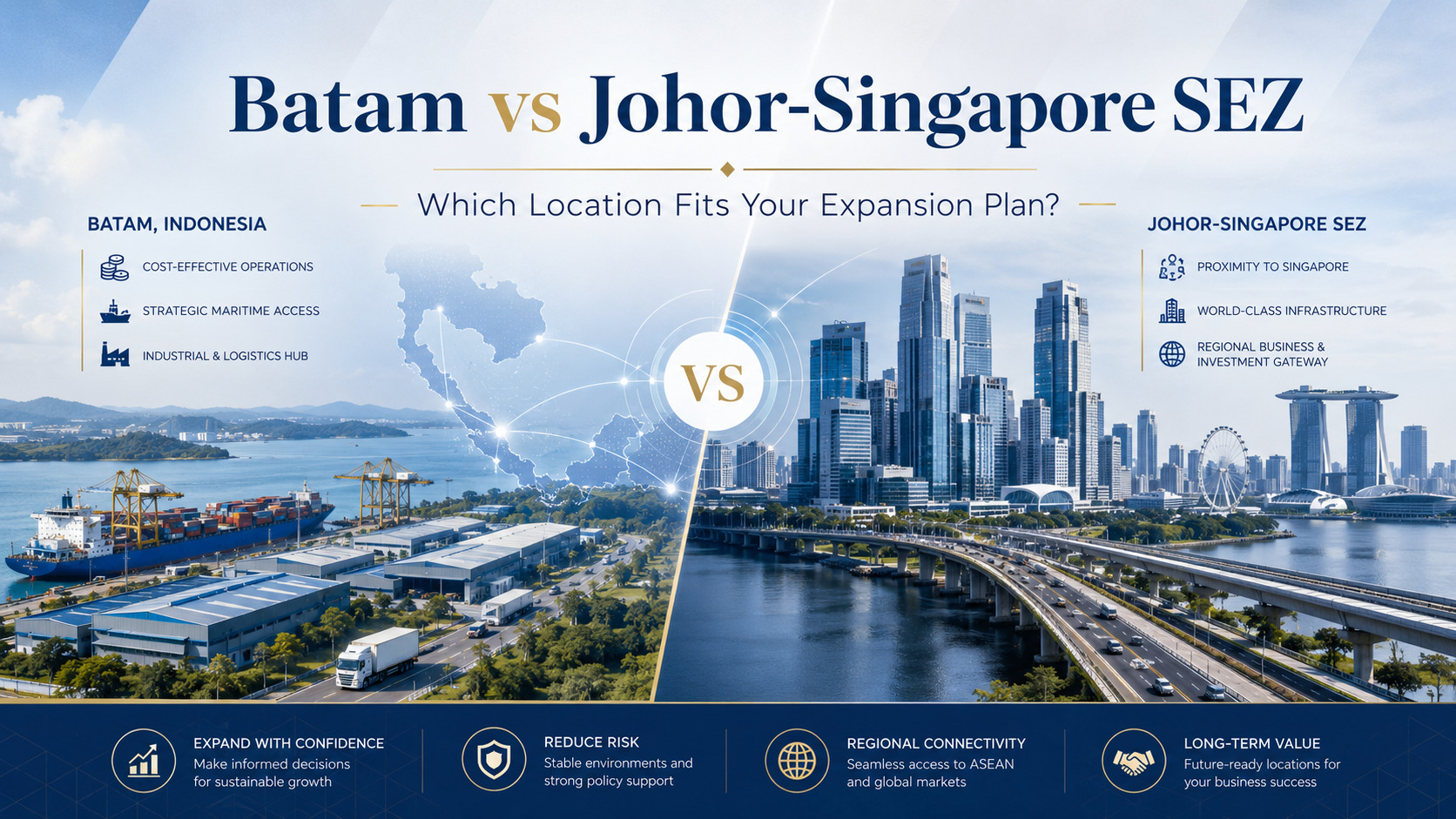
Southeast Asia is becoming one of the most competitive regions for business expansion, manufacturing relocation, digital infrastructure, and regional supply chain diversification. For companies looking at the Singapore Strait as a strategic base, two locations often come into the discussion: Batam, Indonesia and the Johor-Singapore Special Economic Zone, or JS-SEZ.
Both locations are close to Singapore. Both are designed to attract foreign investment. Both offer access to regional supply chains, industrial ecosystems, and competitive operating structures. However, they are not the same.
The right choice depends on your business model, target market, licensing needs, industry sector, tax structure, and long-term expansion plan.
Why Batam and JS-SEZ Are Being Compared
Batam has long been known as one of Indonesia’s most strategic industrial and investment hubs. Its Free Trade Zone status provides benefits such as exemption from VAT, luxury goods tax, and import/export duties, while Batam also has Special Economic Zone developments such as Nongsa Digital Park, Batam Aero Technic, and the Batam Tourism and International Health Zone.
Meanwhile, the Johor-Singapore Special Economic Zone was formally agreed by Malaysia and Singapore in January 2025. The agreement aims to improve cross-border goods connectivity, enable freer movement of people, and strengthen the regional business ecosystem between Johor and Singapore.
For investors, the comparison is clear: Batam offers an Indonesia-focused expansion gateway, while JS-SEZ offers a Malaysia-Singapore cross-border operating model.
1. Strategic Position: Indonesia Gateway vs Singapore-Johor Twinning Model
Batam is located close to Singapore and Malaysia, making it attractive for companies that need proximity to Singapore but want to operate under Indonesia’s market and regulatory framework. It is especially relevant for companies targeting Indonesia’s large domestic market, export manufacturing, logistics, shipbuilding, electronics, digital infrastructure, and MRO activities.
Batam’s economy also showed strong momentum in 2025. BP Batam reported that Batam’s economy grew by 6.76% in 2025, with GRDP reaching Rp253.64 trillion. Manufacturing remained the backbone of the city, contributing 57.01% to GRDP.
JS-SEZ, on the other hand, is built around the idea of combining Singapore’s strengths as a global headquarters, finance, innovation, and connectivity hub with Johor’s land, labour, and industrial capacity. Singapore’s EDB describes this as a “Singapore + twinning model,” where businesses can structure regional or global functions in Singapore while expanding production, logistics, or operational facilities in Johor.
Best fit:
Choose Batam if your expansion plan is focused on Indonesia market access, FTZ benefits, manufacturing, logistics, or cost-efficient regional operations. Choose JS-SEZ if your business needs a Singapore-linked regional structure with Johor-based operational scale.
2. Incentives: Batam FTZ & SEZ Benefits vs JS-SEZ Tax Package
Batam’s main advantage lies in its FTZ and SEZ ecosystem. As an FTZ, Batam provides customs and tax-related facilities including exemption from VAT, luxury goods tax, import duties, and export duties. Its SEZ framework may also provide benefits such as investment allowance, tax holiday, import VAT exemption, and other fiscal facilities depending on the project and eligibility.
JS-SEZ has introduced a more targeted incentive package for high-value investments. Malaysia’s Ministry of Finance announced that qualifying manufacturing and service activities, including AI and quantum computing supply chain, medical devices, aerospace manufacturing, and global services hubs, may benefit from a 5% special corporate tax rate for up to 15 years. Eligible knowledge workers in JS-SEZ may also enjoy a 15% personal income tax rate for 10 years.
MIDA’s incentive snapshot also outlines specific requirements, such as capital investment thresholds, operating expenditure, qualifying activities, workforce conditions, and sector-based eligibility. For example, certain manufacturing incentives require capital investment of at least RM500 million, while knowledge worker incentives include salary and qualification conditions.
Best fit:
Choose Batam if you need practical FTZ customs benefits and Indonesia-based incentives. Choose JS-SEZ if your project qualifies as high-value manufacturing, global services, advanced technology, or knowledge-worker-intensive operations.
3. Industry Focus: Which Sector Fits Better?
Batam is particularly strong for:
- Electronics and electrical manufacturing
- Semiconductors and electronic components
- Shipbuilding and oil & gas equipment
- Industrial machinery
- Software, IT, and digital services
- Logistics, tourism, MRO, health, education, and finance
This makes Batam highly relevant for companies seeking an industrial base near Singapore with access to Indonesia’s regulatory and consumer market.
JS-SEZ covers more than 3,500 km², includes nine flagship zones, and targets 11 sectors, including business services, digital economy, education, energy, financial services, food security, green economy, health, logistics, manufacturing, and tourism.
The JS-SEZ flagship zones include Johor Bahru, Iskandar Puteri, Tanjung Pelepas and Tanjung Bin, Pasir Gudang, Senai-Skudai, Sedenak, Forest City, Desaru, and Pengerang Integrated Petroleum Complex.
Best fit:
Batam is stronger for companies that want Indonesia manufacturing, industrial operations, digital infrastructure, or export-oriented production. JS-SEZ is stronger for companies that need a broader Malaysia-Singapore integrated platform, especially for global services, logistics, advanced manufacturing, and regional headquarters support.
4. Logistics and Connectivity
Batam continues to strengthen its role as a regional logistics hub. In Q1 2026, BP Batam reported container handling volume of 187,000 TEUs, up 12% compared with the same period in 2025. Batu Ampar Container Terminal contributed 128,556 TEUs, or 69% of total throughput, with export-import activities making up 74% of container traffic at Batam Port.
JS-SEZ benefits from direct integration with Singapore and Johor’s transport network. Key initiatives include QR-code clearance at land checkpoints, a one-stop investment facilitation centre in Johor, and streamlined customs procedures for land intermodal transshipments. Singapore’s EDB also notes that the RTS Link between Singapore and Johor is expected to boost mobility by the end of 2026.
Best fit:
Batam is attractive for maritime, export-import, manufacturing, and Indonesia-linked logistics. JS-SEZ is attractive for companies that rely on frequent Singapore-Johor movement of people, goods, management, and services.
5. Licensing and Compliance Considerations
For Batam, foreign investors generally need to consider:
- PT PMA company establishment
- Business Identification Number, or NIB, through OSS
- KBLI business classification
- Risk-based business licensing
- Location and land-use approvals
- Environmental approvals
- Import/export and customs registrations
- BP Batam-related permits for FTZ activities
- Tax, manpower, immigration, and sectoral compliance
Indonesia has also updated its risk-based licensing regime through Government Regulation No. 28 of 2025, which regulates the scope of risk-based business licensing, including basic requirements, business licensing, PB UMKU, OSS services, supervision, evaluation, and sanctions.
For JS-SEZ, investors must assess:
- Malaysian company setup
- MIDA incentive eligibility
- Sector and flagship zone qualification
- Malaysian tax compliance
- Singapore-Malaysia transfer pricing
- Permanent establishment risk
- Employment and knowledge worker eligibility
- Customs and cross-border movement rules
- Substance requirements for tax incentives
Malaysia has also established the Invest Malaysia Facilitation Centre Johor, or IMFC-J, to coordinate applications, approvals, investment facilitation, and reinvestment in JS-SEZ.
Best fit:
Batam may be more suitable if your primary compliance pathway is Indonesia-focused. JS-SEZ may be more suitable if your structure involves both Singapore and Malaysia and requires careful cross-border tax planning.
Batam vs Johor-Singapore SEZ: Quick Comparison Table
| Factor | Batam, Indonesia | Johor-Singapore SEZ |
|---|---|---|
| Main Positioning | Indonesia investment and industrial gateway | Singapore-Johor cross-border growth corridor |
| Best For | Manufacturing, logistics, shipbuilding, electronics, digital infrastructure, MRO, Indonesia market entry | Regional HQ support, high-value manufacturing, logistics, global services, Singapore-Johor twinning |
| Incentive Style | FTZ and SEZ facilities, customs and tax benefits | Targeted tax incentives, 5% corporate tax for qualifying projects, 15% knowledge worker tax |
| Market Access | Indonesia domestic market + export base | Malaysia market + Singapore-linked regional operations |
| Compliance Focus | PT PMA, OSS, KBLI, BP Batam, customs, tax, manpower | Malaysian entity, MIDA, IMFC-J, Singapore-Malaysia tax structuring |
| Logistics Strength | Maritime, port, export-import, industrial supply chain | Land connectivity, Singapore-Johor movement, regional service integration |
| Ideal Investor | Companies wanting cost-efficient Indonesia operations near Singapore | Companies wanting integrated Singapore-Malaysia operations |
Which Location Should You Choose?
There is no one-size-fits-all answer. The right location depends on your expansion objective.
Choose Batam if your company wants to:
- Enter or expand in Indonesia
- Build a cost-efficient manufacturing or logistics base
- Benefit from FTZ and SEZ facilities
- Operate near Singapore while using Indonesia as the legal and operational base
- Develop export-oriented production, digital infrastructure, MRO, or industrial services
Choose Johor-Singapore SEZ if your company wants to:
- Use Singapore as a regional HQ, finance, R&D, or management hub
- Place operational or manufacturing capacity in Johor
- Qualify for Malaysia’s targeted JS-SEZ incentives
- Benefit from Singapore-Johor cross-border connectivity
- Build a dual-country regional operating model
For some companies, the best strategy may not be choosing one over the other. A dual-hub strategy can also make sense: Batam for Indonesia-facing operations and JS-SEZ for Singapore-Malaysia regional integration.
Final Takeaway
Batam and the Johor-Singapore SEZ are not simply competitors. They represent two different expansion models in Southeast Asia.
Batam is the stronger choice for companies that want to establish a strategic base inside Indonesia with industrial, logistics, and FTZ advantages.
JS-SEZ is the stronger choice for companies that want to leverage Singapore and Johor together through an integrated cross-border operating model.
Before deciding, investors should assess their business activity, sector eligibility, tax exposure, licensing requirements, supply chain route, staffing plan, and long-term market strategy.
CTA
Planning to expand your business into Batam, Indonesia, or compare your options with the Johor-Singapore SEZ?
Accura can help you assess the right structure, licensing route, company setup, investment compliance, and operational strategy for your expansion plan. From PT PMA establishment and OSS licensing to immigration, tax, and sectoral compliance, our team can guide your market entry from planning to execution.
Contact Accura today to discuss the most suitable expansion location for your business.