
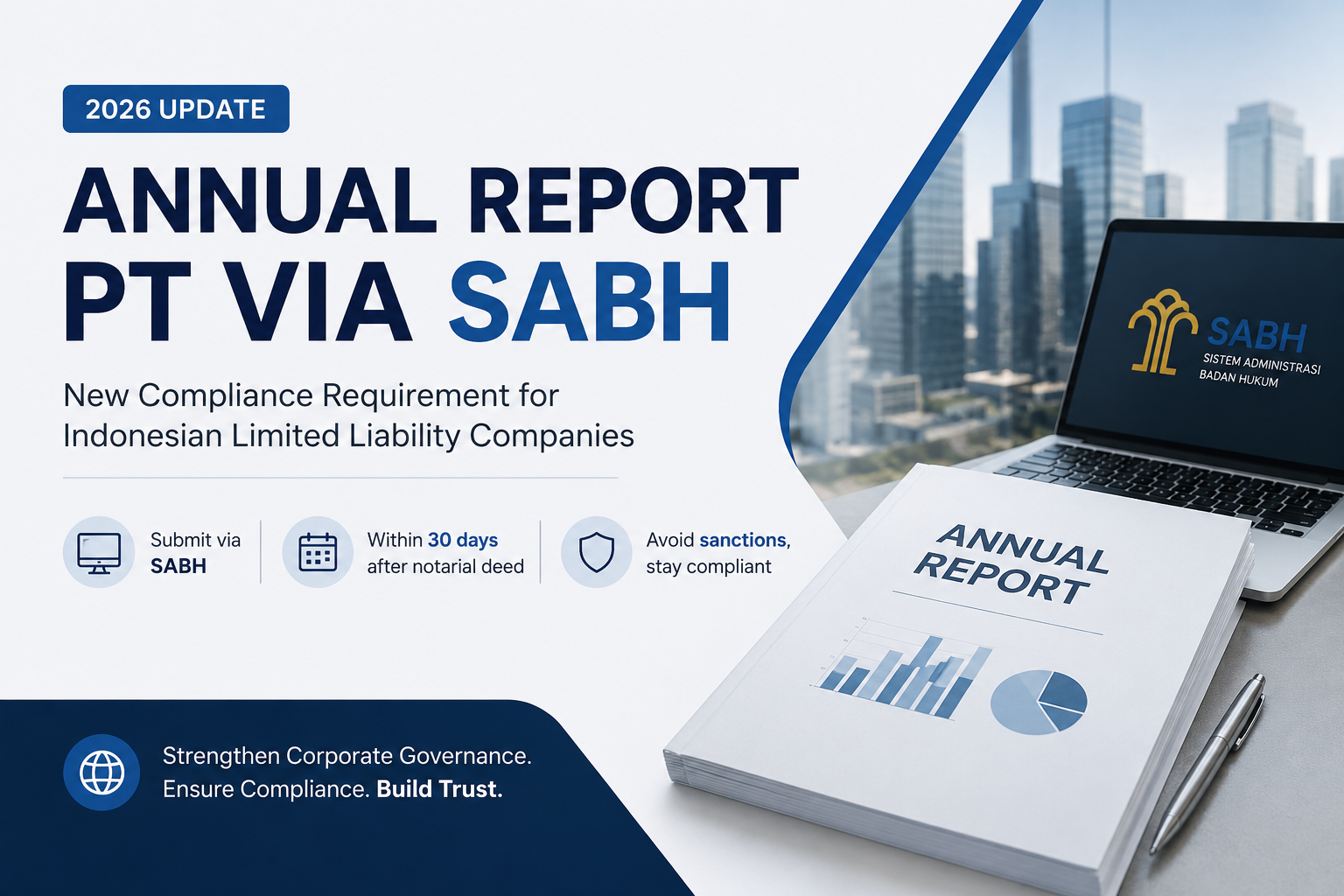
Indonesia has introduced a new compliance requirement for limited liability companies, commonly known as Perseroan Terbatas or PT. Under Minister of Law Regulation No. 49 of 2025, certain PT companies are now required to submit their annual report through the Legal Entity Administration System, known as Sistem Administrasi Badan Hukum or SABH.
This change is important for shareholders, directors, foreign investors, and corporate secretarial teams because annual reporting is no longer only an internal corporate governance matter. It has become part of ongoing administrative compliance with the Ministry of Law.
For businesses operating in Indonesia, the Annual Report PT via SABH requirement should be treated as a key corporate housekeeping obligation in 2026 and beyond.
What Is the Annual Report PT via SABH Requirement?
The Annual Report PT via SABH requirement refers to the obligation of a PT to submit its annual report approval to the Minister of Law electronically through SABH.
Previously, many private companies mainly treated annual reports as documents prepared for approval at the Annual General Meeting of Shareholders, or RUPS Tahunan. With the issuance of Minister of Law Regulation No. 49 of 2025, the approved annual report must also be submitted through the official legal entity administration system.
In practice, this means that the company must prepare the annual report, obtain review from the Board of Commissioners where applicable, secure approval from the shareholders through RUPS, record the approval in a notarial deed, and submit the required documents electronically through SABH via a notary.
Why This Matters for Companies in Indonesia
The new SABH annual report requirement strengthens corporate transparency and administrative discipline. For companies, it may affect future legal actions and corporate transactions.
Based on recent AHU implementation updates, the status of annual report submission may be checked during substantive verification for certain corporate changes, such as changes to directors and commissioners, share transfers, or changes to shareholder names.
This means that a company that delays or ignores its annual report submission may face practical obstacles when it needs to update corporate data, restructure shareholding, or proceed with corporate actions through SABH.
For foreign investors, this is especially relevant because the company’s legal administration status can influence transaction readiness, due diligence results, and post-investment compliance.
Legal Basis: Permenkum 49/2025
The key legal basis is Minister of Law Regulation No. 49 of 2025 concerning the Requirements and Procedures for the Establishment, Amendment, and Dissolution of Limited Liability Company Legal Entities.
This regulation was stipulated on 11 December 2025, promulgated on 17 December 2025, and replaced Minister of Law and Human Rights Regulation No. 21 of 2021.
One of the most important changes introduced by the regulation is the obligation for Perseroan Persekutuan Modal, or capital partnership companies, to submit annual report approval to the Minister through SABH.
Who Must Submit the Annual Report via SABH?
The annual report obligation under Article 16 of Permenkum 49/2025 applies to Perseroan Persekutuan Modal. In general business terms, this refers to conventional limited liability companies established by more than one shareholder.
This is different from Perseroan Perorangan, or individual limited liability companies, which are subject to separate financial reporting obligations.
For companies with foreign shareholders, investment companies, operating subsidiaries, and private companies with multiple shareholders, this requirement should be reviewed carefully with the company’s notary or corporate secretarial adviser.
Key Deadlines Companies Should Know
There are two main timing points to understand.
First, the Board of Directors must submit the annual report to the Annual General Meeting of Shareholders after it has been reviewed by the Board of Commissioners. This must be done no later than six months after the company’s financial year ends.
For companies using a calendar financial year ending on 31 December, this generally means the annual report and RUPS approval process should be completed by 30 June of the following year.
Second, once the annual report has been approved by the RUPS and recorded in a notarial deed, the approval must be submitted to the Minister of Law through the notary no later than 30 days after the notarial deed is signed.
In 2026, AHU has also started implementing the annual report submission requirement through SABH as of 1 June 2026. Companies should not wait until sanctions are enforced before completing the submission.
Documents Required for Annual Report Submission
Under Permenkum 49/2025, the supporting documents for submission through SABH include:
- The notarial deed concerning the approval of the annual report; and
- The annual report itself.
The annual report must at least include the following information:
- Financial statements, including the balance sheet, profit and loss statement, cash flow statement, statement of changes in equity, and notes to the financial statements;
- Report on the company’s activities;
- Report on the implementation of social and environmental responsibility;
- Details of issues arising during the financial year that affected the company’s business activities;
- Report on the supervisory duties carried out by the Board of Commissioners;
- Names of members of the Board of Directors and Board of Commissioners;
- Salary, honorarium, allowances, and other benefits for the Board of Directors and Board of Commissioners.
These requirements show that the annual report is not merely a financial document. It also serves as a corporate governance document that reflects the company’s operational, supervisory, and accountability structure.
Are There Sanctions for Not Submitting?
Yes. Permenkum 49/2025 provides administrative sanctions for companies that fail to comply or miss the deadline.
The sanctions may include:
- Written warning; and
- Blocking of the company’s access to SABH.
Based on the regulation, the written warning may be delivered through SABH notification and/or email once the company has passed the deadline. If the company still does not fulfil the obligation within 30 days after the warning, it may face administrative blocking of its SABH access.
Recent AHU implementation updates also indicate that administrative sanctions are planned to start being enforced in November 2026. However, even before sanctions are enforced, annual report submission status may already be relevant in the verification of certain corporate transactions.
What Happens If SABH Access Is Blocked?
If a company’s access to SABH is blocked, it may face difficulty processing legal entity administration matters. This can affect corporate activities such as amendments to company data, changes in directors or commissioners, shareholder updates, share transfers, or other corporate actions requiring AHU/SABH processing.
For businesses, the impact can be more than administrative. Delayed corporate filings may disrupt transactions, investor onboarding, financing, internal restructuring, or legal due diligence.
The company may apply to reopen the blocked SABH access, but it will need to complete the required annual report submission documents.
Practical Compliance Checklist for PT Companies
To prepare for the Annual Report PT via SABH requirement, companies should take the following steps:
- Review the company’s financial year-end date.
- Prepare the annual financial statements and supporting annual report information.
- Arrange internal review by the Board of Commissioners, if applicable.
- Hold the Annual General Meeting of Shareholders within the required timeline.
- Ensure the RUPS approval is recorded in a notarial deed.
- Coordinate with the notary to submit the annual report approval through SABH.
- Keep evidence of submission and the receipt notification from the system.
- Monitor future AHU updates, especially on sanctions and applicable fees.
At the initial implementation stage, AHU has also indicated that the annual report submission has not yet been subject to Non-Tax State Revenue, or PNBP, until the relevant government regulation on applicable fees is issued.
Key Takeaways for Foreign Investors
For foreign investors in Indonesia, this new reporting obligation should be included in the company’s annual compliance calendar.
The annual report via SABH is important because it may affect the company’s ability to process corporate changes and demonstrate good corporate governance. Investors acquiring shares in an Indonesian PT should also check whether the target company has fulfilled its annual report obligations as part of legal due diligence.
This requirement reflects Indonesia’s broader move toward stronger transparency, digital administration, and continuous corporate compliance.
Conclusion
The Annual Report PT via SABH requirement under Permenkum 49/2025 is a major update for Indonesian company compliance in 2026. PT companies should no longer treat annual reports as purely internal shareholder documents. Once approved by the RUPS and recorded in a notarial deed, the annual report must be submitted electronically through SABH.
Companies should act early, coordinate with their notary, and ensure that annual reporting is completed properly to avoid administrative risks, transaction delays, and potential blocking of SABH access.
For businesses and foreign investors, timely compliance is not just about avoiding sanctions. It is about maintaining corporate readiness, legal certainty, and investor confidence in Indonesia.
Disclaimer: This article is for general information only and does not constitute legal advice. Companies should consult their legal adviser, notary, or corporate secretarial provider to assess their specific obligations.