
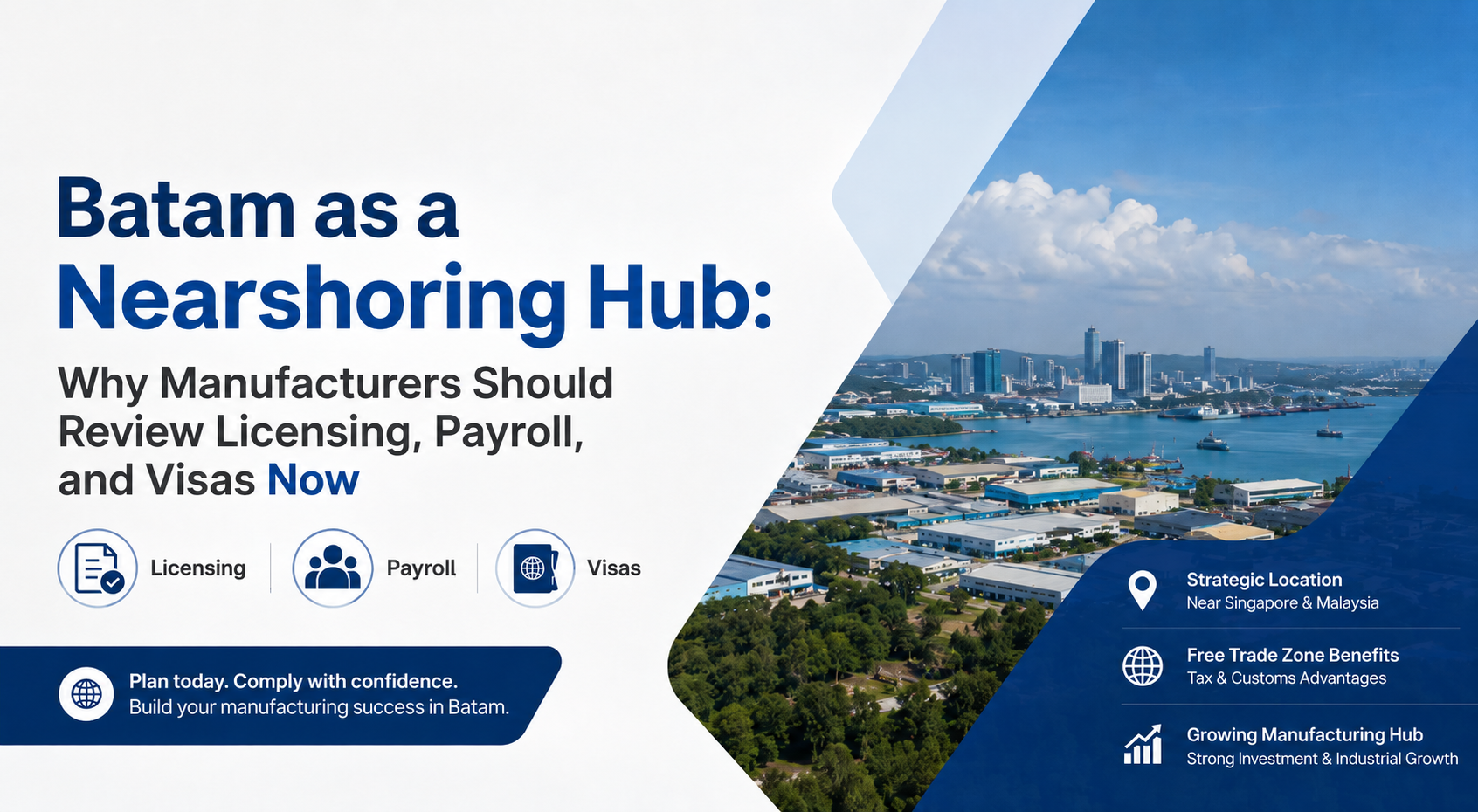
Global manufacturers are rethinking where and how they produce. Rising tariffs, geopolitical uncertainty, longer lead times, and pressure to diversify beyond a single production base have made Southeast Asia a stronger destination for supply chain relocation. ASEAN has already shown strong momentum, with FDI inflows rising to USD226 billion and manufacturing FDI growing sharply, according to the ASEAN Investment Report 2025.
Within Indonesia, Batam is increasingly positioned as a practical nearshoring hub. Located close to Singapore and Malaysia, supported by industrial estates, port access, and Free Trade Zone facilities, Batam gives manufacturers a strategic base for regional production, assembly, logistics, and export-oriented operations.
But before expanding or relocating production, companies should not only look at factory space and operating costs. They also need to review three critical compliance areas: licensing, payroll, and visas.
Why Batam Is Back on Manufacturers’ Radar
Batam has long been known as one of Indonesia’s most strategic industrial locations. Its proximity to Singapore and Malaysia, access to international shipping routes, and role as part of Indonesia’s Free Trade Zone ecosystem make it attractive for manufacturers seeking regional supply chain efficiency.
The numbers also support the momentum. BP Batam reported that Batam’s economy grew 6.76% in 2025, with Q4 growth reaching 7.49% year-on-year. The manufacturing sector contributed more than 57% to Batam’s regional GDP, while investment increased by 9.53%.
For companies applying a China+1, ASEAN+1, or regional diversification strategy, Batam can offer several advantages: access to Singapore-linked supply chains, competitive industrial capacity, proximity to regional customers, and fiscal/customs facilities through the Free Trade Zone framework.
1. Licensing: Make Sure the Business Structure Still Fits the Operation
Manufacturers entering Batam need to ensure that their business licensing is aligned with their actual activities. This includes the correct KBLI business classification, NIB, risk-based business licenses, environmental approvals, industrial location, import/export access, and any sector-specific operational permits.
Indonesia’s OSS system is designed to simplify business licensing, and BP Batam’s investment FAQ explains that applications can be submitted through OSS, with the NIB including company registration, import identification, and customs access.
For Batam specifically, companies should also review whether their activities qualify for Free Trade Zone treatment. Indonesia’s Customs authority explains that KPBPB/FTZ areas provide facilities such as exemption from import duty, VAT, luxury goods sales tax, and excise, subject to applicable rules and supervision.
Manufacturers should review licensing now because expansion often changes the compliance profile. A company that starts with trading or light assembly may later move into full-scale manufacturing, warehousing, import of raw materials, export distribution, or hiring foreign technical staff. Each change can trigger additional licensing, customs, tax, manpower, or immigration obligations.
2. Payroll: Batam Cost Planning Must Include Local Wage and Statutory Obligations
Payroll in Batam is not only about monthly salary. Manufacturers must account for local minimum wage, BPJS social security contributions, overtime, THR, income tax withholding, employment agreements, and proper payroll documentation.
For 2026, the Batam minimum wage is set at Rp5.357.982, up 7.38% from 2025, and applies from 1 January 2026.
Employers should also manage BPJS Ketenagakerjaan and BPJS Kesehatan obligations. BPJS Ketenagakerjaan covers programs such as JHT, JKK, JP, and JKM, with contribution structures shared between employer and employee depending on the program.
From a tax perspective, payroll must also handle Article 21 income tax withholding. The Directorate General of Taxes explains that employers withhold Article 21 income tax and employees are entitled to withholding tax receipts such as Form 1721-A1.
For manufacturers with shift work, production peaks, and overtime-heavy operations, payroll review is especially important. Mistakes in wage structure, overtime calculation, BPJS registration, or tax withholding can create disputes, audit exposure, and unexpected labor cost increases.
3. Visas and Work Permits: Foreign Technical Staff Need Proper Planning
Many manufacturers entering Batam rely on foreign directors, engineers, production specialists, quality-control experts, or technical trainers during setup and early production stages. This makes visa and work permit planning essential.
Indonesia requires employers to comply with the RPTKA framework before employing foreign workers. Kemnaker has emphasized that RPTKA is mandatory before foreign workers perform work activities in Indonesia.
Immigration compliance is equally important. Indonesia’s eVisa information states that work-related stay permits may allow employment-related activities, but foreign nationals must comply with Indonesian laws, employment contracts, and visa conditions.
Manufacturers should avoid sending foreign staff to Batam under the wrong visa category for activities that are effectively employment, technical work, or long-term operational support. The safer approach is to map each foreign worker’s role, duration, location, employer sponsor, and job title before deployment.
Practical Compliance Checklist for Manufacturers in Batam
Before entering or expanding in Batam, manufacturers should review:
- Business licensing — KBLI, NIB, OSS risk-based license, industrial permits, environmental approvals, import/export access, and FTZ/customs requirements.
- Entity structure — whether the company is set up correctly for manufacturing, trading, warehousing, distribution, or export activity.
- Payroll setup — Batam minimum wage, BPJS, PPh 21, THR, overtime, shift allowance, and employment contract structure.
- Foreign worker planning — RPTKA, visa index, ITAS/KITAS, job title alignment, contract duration, and reporting obligations.
- Operational readiness — customs documentation, HS code classification, bonded/FTZ treatment, logistics flow, and supplier/customer contracts.
- Internal audit schedule — periodic review of licenses, payroll files, tax reports, and immigration documents before renewal deadlines.
Conclusion: Batam Offers Opportunity, but Compliance Should Come First
Batam’s strategic location, Free Trade Zone advantages, manufacturing base, and growing investment momentum make it a strong candidate for manufacturers looking to nearshore or diversify their regional supply chains. However, the opportunity should be approached with proper compliance planning.
For companies considering Batam, now is the right time to review licensing, payroll, and visa requirements before operational decisions become costly to correct later.
Accura can assist foreign companies and manufacturers in reviewing business licensing, payroll compliance, and visa requirements for operations in Batam and across Indonesia.