
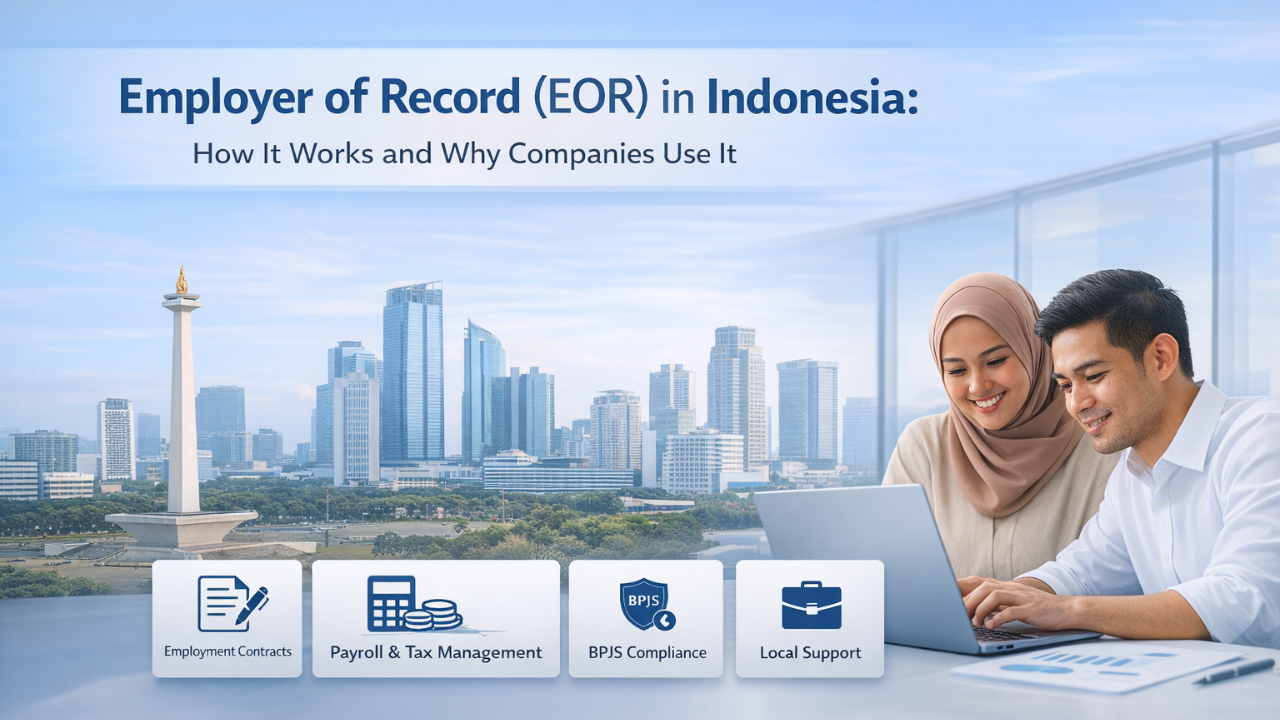
Employer of Record Indonesia is becoming a popular solution for foreign companies that want to hire employees without establishing a local entity. When companies plan to expand into Indonesia, hiring employees usually requires setting up a registered company. However, through an Employer of Record (EOR) arrangement, businesses can legally employ staff while the EOR provider manages payroll, employment contracts, and compliance with Indonesian labor regulations.
Through an EOR arrangement, a local company acts as the legal employer while the foreign company manages the employee’s day-to-day work. This structure allows companies to hire talent in Indonesia without establishing a local entity, while still complying with Indonesian employment and payroll regulations.
To understand why this model is increasingly used by global companies, it is important to first understand how EOR services actually work in Indonesia.
What Is Employer of Record Indonesia (EOR)?
An Employer of Record (EOR) is a locally registered company that legally employs personnel on behalf of another company.
In this arrangement:
- The EOR becomes the legal employer in Indonesia
- The client company manages the employee’s operational work
The EOR provider handles all legal and administrative responsibilities related to employment, including employment agreements, payroll processing, and statutory compliance.
How Employer of Record Works in Indonesia
Professional EOR services are structured around several key operational functions that ensure compliance with Indonesian regulations.
1. Acting as the Legal Employer of Record
The EOR provider acts as the legal employer for assigned personnel in Indonesia.
This includes:
- formally employing the personnel under Indonesian law
- representing the employee relationship for legal and regulatory purposes
- ensuring the employment arrangement complies with local labor regulations.
Although the EOR is the legal employer, the client company continues to manage the employee’s daily responsibilities and business activities.
2. Issuing Local Employment Agreements
One of the most important functions of the EOR is preparing and executing local employment agreements.
These agreements must comply with Indonesian labor regulations, including the Manpower Law and its amendments under the Job Creation Law.
By using locally compliant contracts, companies can ensure that employment terms follow Indonesian legal requirements while still reflecting the operational needs of the client company.
3. Managing Payroll Administration
Payroll administration is another core part of EOR services.
This includes:
- end-to-end monthly payroll processing
- salary and benefit calculations
- preparation and issuance of digital payslips
- payroll reporting and administration.
Payroll processing must be handled carefully to ensure accuracy and compliance with Indonesian employment regulations.
4. Handling Tax Withholding and Statutory Contributions
Employers in Indonesia are required to administer several statutory obligations related to employee compensation.
Through the EOR structure, the provider manages:
- calculation and withholding of income tax (PPh 21)
- registration and administration of BPJS Ketenagakerjaan and BPJS Kesehatan
- payment of mandatory social security contributions.
These contributions form part of Indonesia’s national social security and employment protection system.
5. Providing Local Administrative and Compliance Support
Beyond employment contracts and payroll, EOR providers also offer in-country administrative support.
This may include:
- coordination of insurance arrangements
- administrative assistance related to employee documentation
- representation as the local employer for regulatory matters.
This local support is especially important for foreign companies that do not yet have an HR or compliance team in Indonesia.
6. Employment Compliance and Termination Procedures
Indonesian labor regulations require specific procedures when managing employment matters, including termination.
Under a typical EOR structure:
- employment decisions remain aligned with the client company
- the EOR ensures that any employment action complies with Indonesian labor law.
The EOR provider generally cannot terminate assigned personnel without the client company’s prior approval unless termination is required under applicable law or in cases of serious misconduct.
Why Companies Use Employer of Record in Indonesia
After understanding how EOR services work, the next question is why companies choose this model.
There are several strategic reasons.
Faster Market Entry
Setting up a company in Indonesia can take several months due to licensing and administrative procedures.
EOR allows companies to hire employees much faster, enabling them to start operations or test the market without waiting for a full company establishment.
Reduced Administrative Complexity
Managing employment compliance in Indonesia involves multiple administrative processes, including payroll management, tax withholding, and social security registration.
Through an EOR arrangement, these responsibilities are handled by a local provider that is familiar with Indonesian regulatory requirements.
Lower Expansion Risk
Many companies use EOR as a market entry strategy.
Instead of committing immediately to establishing a legal entity, they can hire key personnel, explore the market, and evaluate expansion opportunities before making a long-term investment.
Support for Remote and Distributed Teams
As more companies adopt remote working models, hiring employees across borders has become increasingly common.
EOR services allow companies to employ Indonesian talent legally while ensuring compliance with local labor regulations.
When Should a Company Use an EOR?
Employer of Record services are commonly used when companies:
- are entering the Indonesian market for the first time
- want to hire one or two employees locally
- are testing regional expansion
- are building remote teams in Southeast Asia.
For larger operations with many employees, companies may eventually decide to establish their own local entity.
Conclusion
Employer of Record services have become an important solution for international companies that want to hire employees in Indonesia without establishing a local entity.
By acting as the legal employer, managing payroll administration, and ensuring compliance with Indonesian labor and tax regulations, an EOR provider enables companies to focus on their core business activities while maintaining regulatory compliance.
For many businesses entering Indonesia, EOR represents a practical and efficient way to begin building a local team.